On 2 December 2025, stakeholders from government, private sector, development partners, and research institutions convened in Lilongwe for a results dissemination event on the potential of anchor enterprise models to accelerate rural and agricultural transformation in Malawi. The event, organized by IFPRI with financial support from the Embassy of Ireland, featured a presentation of research findings, and a dynamic panel discussion with key actors in Malawi’s agricultural sector and general discussion among key actors in the agriculture sector.
Charting the Course: Perspectives from Policy and Development Partners
Fredrick Changaya, Director General of the National Planning Commission (NPC), opened the meeting with a passionate call for innovation and policy alignment. He emphasized that Malawi cannot rely on traditional approaches alone to achieve transformation, noting that “agriculture alone cannot transform Malawi. We need models that pull and professionalize the sector, creating partnerships that go beyond funding.” While acknowledging past efforts, he urged stakeholders to embrace evolution and build on lessons learned to create models that integrate risk-sharing, equity, and scalability. Changaya stressed that agricultural transformation requires complementary sectors and strong policy frameworks, warning that without alignment, even the best ideas risk being sidelined.
Sarah McCan, Head of Cooperation at the Embassy of Ireland, reinforced this message by highlighting Ireland’s strategic shift in agricultural programming. She explained that decades of traditional smallholder support yielded mixed results, prompting a pivot toward commercialization and private sector partnerships. “We recognized the need for a new approach - partnering with the private sector to include smallholders in sustainable, profitable markets,” she said, emphasizing that success must be measured not only by profitability but also by improved food security and incomes for smallholder farmers. McCan acknowledged challenges with the anchor enterprise models such as macroeconomic instability and side-selling but expressed optimism that evidence-based approaches can guide programming and policy toward more resilient and inclusive systems.
Evidence for action: what the study reveals
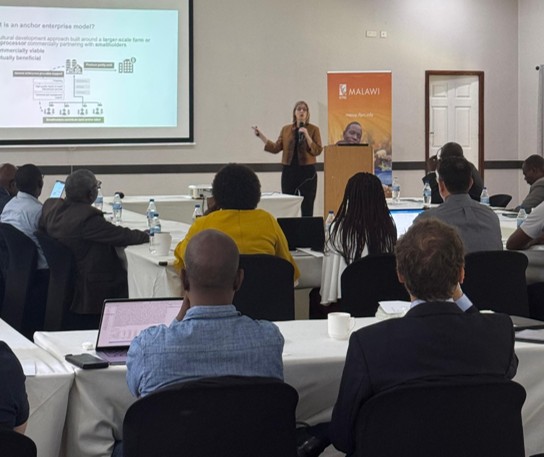
The presentation by Lara Cockx, IFPRI Research Fellow, provided clarity on what anchor enterprise models entail and when they make economic sense. These models center on partnerships between large farms or agro-processors and smallholder farmers, designed to reduce transaction costs, overcome market inefficiencies, and leverage economies of scale. Cockx explained that such models are most viable for specialized agricultural products such as horticulture or other high-value export crops, rather than generic staples like maize, where open-market sourcing is cheaper and less risky. She highlighted that while these partnerships can improve productivity and incomes for participating farmers, they are unlikely to include and directly benefit the poorest households due to land and capacity constraints. The study also identified critical success factors: strong incentives for both parties, clear agreements, effective monitoring, and an enabling environment characterized by macroeconomic stability, rural infrastructure, and supportive legal frameworks. Importantly, Cockx cautioned that anchor enterprise models are not a universal solution but a targeted approach that can complement other strategies for inclusive rural development.
Insights from Practice: What Works and What Doesn’t
A panel discussion brought together diverse perspectives from government and agribusiness, offering practical insights into implementation challenges and opportunities:
- Henry Msatilomo, Director of the Mega Farm Support Department, explained that Malawi’s mega farm program was conceived with “anchor” principles in mind, aiming to create innovation hubs that support surrounding farmers. While progress has been made, issues such as financing gaps and farmer defaults remain significant hurdles. He called for stronger due diligence and incentives to foster genuine partnerships.
- Ignatious Majamanda, Director of Primary Production, Malawi Mangoes shared how working with cooperatives has improved quality and quantity, enabling compliance with international standards. He stressed the importance of targeted investments in irrigation and accreditation to unlock export potential.
- Tadala Rambiki, Commercial production manager, Pyxus, reflected on the trade-offs between contracting individual farmers versus farmer organizations. Individual contracts offer clarity and accountability, while cooperatives facilitate aggregation and peer enforcement. However, group dynamics and uneven understanding of agreements can pose challenges.
- Felix Sichali, Head of Business and Market Development, NASFAM, drew lessons from in-grower and out-grower models. In-grower arrangements, where farmers cultivate within the anchor farm under close supervision, have yielded better results in technology adoption, loan repayment, and market compliance compared to out-grower models, which face higher risks of side-selling.
- Teddie Nakhumwa, National Coordinator for the national flagship project, the Agriculture Commercialization Project (AGCOM), emphasized the need for enforceable contracts and long-term relationships to safeguard investments. He noted that legal gaps and weak enforcement discourage enterprises from providing comprehensive support, limiting the transformative potential of these models.
Looking Ahead: Turning Evidence into Action
Joachim De Weerdt, IFPRI Country Program Leader, summarized the day’s key message: “Malawi must transition from fragmented, low-value chains to modern, organized, and export-oriented systems.” He noted that anchor enterprise models offer a pathway to leverage private sector strengths such as capital, technology, and market access while extending benefits to smallholders. However, success depends on collaboration, enabling policies, and realistic expectations about inclusivity. He commended Ireland for championing innovative approaches and stakeholders for their candid engagement.
Readwell Musopole, Deputy Director of Planning, Ministry of Agriculture, speaking on behalf of the Principal Secretary, reaffirmed government commitment to anchor farms as a priority under Malawi 2063, stating that “anchor farms remain a priority under Malawi 2063. This discussion provides valuable input for refining our approach to ensure food security, income growth, and foreign exchange earnings.”
Unlocking Potential: What Needs to Happen Next
To scale anchor enterprise models successfully, Malawi must create an enabling environment for such enterprises to operate in through macroeconomic stability and regulations that facilitate private investment in agri-business and exports, while improving rural infrastructure. Legal frameworks for contract enforcement are essential to build trust and minimize defaults, complemented by farmer-friendly contract templates and dispute resolution mechanisms. Capacity building for smallholders and enterprises can enhance financial literacy and partnership management, while effective farmer organizations can serve as intermediaries to reduce coordination costs. Risk mitigation tools like agricultural insurance and group-based repayment schemes can be explored to safeguard investments. Finally, targeted investments in technology, mechanization, and quality certification systems will enable anchor enterprises and their smallholder partners to meet high-value market requirements and compete globally.
Resources:
Read and download the presentation here (PDF 690 KB)
Policy Note 54: The development potential of anchor enterprise models in Malawi (PDF 229 KB)