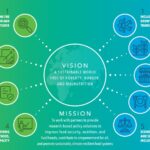
IFPRI’s Strategy for 2026–2030 reaffirms the Institute’s commitment to providing research-based policy solutions. IFPRI works with partners to use the power of policy to improve food security, nutrition, and livelihoods, contribute to empowerment, and promote sustainability and climate resilience, particularly in low- and middle-income countries. This new strategy responds to the many challenges and opportunities emerging today, […]
Steven Were Omamo appointed IFPRI’s Director for Africa

The International Food Policy Research Institute (IFPRI) is pleased to announce that Steven Were Omamo has been appointed IFPRI’s Director for Africa. Dr. Omamo will also continue to serve as IFPRI’s Director of the Development Strategies and Governance Unit (DSG).
More than a meal: How school feeding programs are shaping the future

For more than a century, countries around the world have recognized school meals as a powerful tool for preventing hunger among the most vulnerable children and easing financial pressure on struggling households. Now, in the face of complex and evolving global crises such as failing food systems, malnutrition, educational challenges, economic instability, and climate change, […]
Revisiting development strategies under climate uncertainty: Insights from Malawi
Climate change is transforming the global landscape, creating unprecedented challenges for developing countries. These challenges are particularly acute in regions where economies heavily depend on agriculture, such as sub-Saharan Africa, where climate impacts such as droughts and extreme weather are increasingly disrupting farming economies and food systems. One of the critical questions facing policymakers is […]
Behavioral explanations for the sell-low-buy-high puzzle in smallholder market participation: Lessons from a field experiment in Malawi
In rural markets of developing countries, agricultural commodity prices exhibit seasonal fluctuations, with low prices at harvest, followed by steady rises to an annual high shortly before lean-season planting. Ideally, an economically rational farmer should delay sales until prices recover. Instead, it is often observed that smallholder farmers sell most of their marketable surplus right after harvest, […]
- 1
- 2
- 3
- …
- 46
- Next Page »